
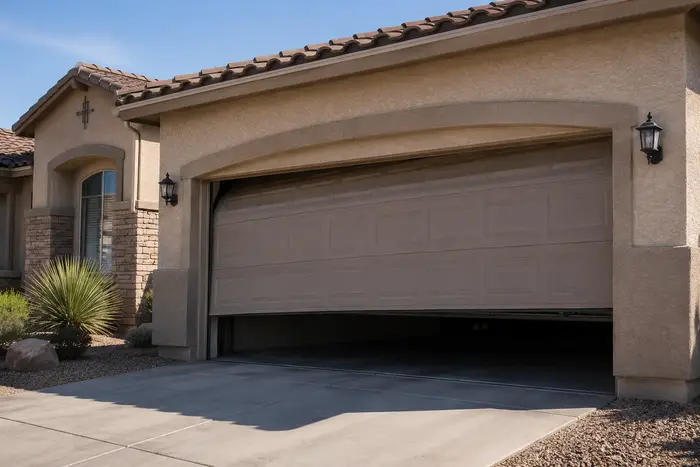
If your garage door won’t open right now, here is exactly what you need to do: stay calm, do not force the door, and follow the steps below. Most garage door emergencies in Odessa, TX, come down to a handful of causes, and some of them you can check safely on your own in less than five minutes before you decide whether to call a technician.
This guide walks you through every step from initial troubleshooting to understanding when the repair is beyond DIY, written specifically for homeowners in Odessa, Midland, West Odessa, Gardendale, Andrews, and Monahans.
1:Why Garage Doors Stop Working Without Warning
Garage doors in the Permian Basin deal with some of the harshest conditions in West Texas. Extreme summer heat, blowing dust, and the constant vibration from heavy road traffic all wear down components faster than the national average. A door that worked perfectly yesterday can fail overnight, and it usually comes down to one of these causes.
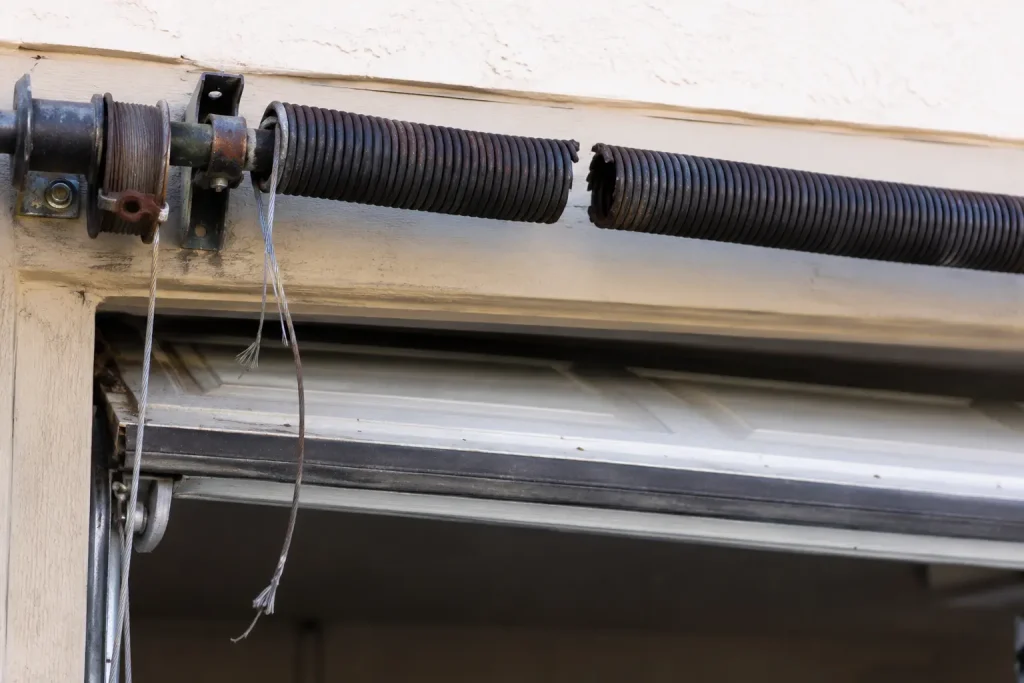
- Broken torsion or extension springs are the single most common reason a garage door refuses to open. Springs are responsible for counterbalancing the full weight of the door, which typically runs between 150 and 300 pounds. When a spring snaps, the opener motor cannot lift that weight alone, and the door stays flat on the ground. You may hear a loud bang when it breaks, almost like a gunshot inside the garage.
- A snapped cable is the second most common cause. Steel lift cables run along both sides of the door and work together with the springs. When one frays or breaks, the door can go off-track or hang at an angle. This is a garage door safety hazard, and the door should not be operated until a technician repairs it.
- Misaligned or bent tracks are another frequent culprit, especially after a vehicle bumps the door or after ground settlement shifts the frame. Even a small bend in the vertical or horizontal track can jam the rollers completely.
- Opener failures cover everything from a burned-out motor to stripped drive gears, faulty logic boards, or dead capacitors. Odessa summers push garage temperatures well past 120 degrees Fahrenheit inside an uninsulated garage, and that heat accelerates wear on every electrical component in your opener.
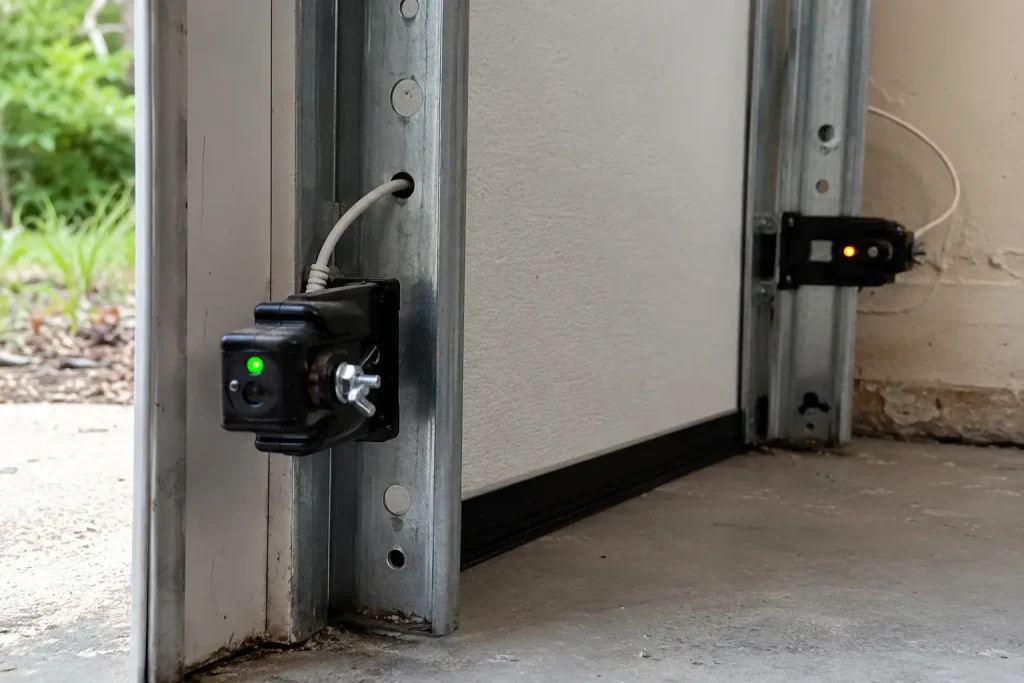
- Dead or misaligned safety sensors will also prevent the door from opening. The two small sensors mounted a few inches off the ground on either side of the door must maintain a clear line of sight to each other. If one gets knocked out of alignment, gets coated in dust, or has a frayed wire, the opener will not run a full cycle.
Finally, a dead remote or keypad battery is worth checking before anything else because it is free to fix.
2:Step-by-Step: What to Check Before You Call Anyone
Step 1: Check the obvious first
Look at the wall button inside the garage. If pressing the wall button opens the door but your remote does not, the issue is just the remote battery. Replace the CR2032 or AA batteries in the remote and try again.
Also, check whether the opener unit has power. If the light on the opener is out and pressing any button does nothing, check the outlet it plugs into and reset any tripped breakers in your panel.
According to DASMA Garage Door Safety Tips, homeowners should never attempt spring repairs without proper tools and training.
Step 2: Look at the safety sensors
Walk to the bottom corners of the door opening. You will see two small sensor units, one on each side, about four to six inches off the ground. One has a green LED, and one has an amber LED. Both lights should be solid and steady.
If either light is blinking or off, the sensors are misaligned or blocked. Wipe the lenses with a dry cloth to remove any dust or spider webs. Then gently adjust the sensor housing until both lights go solid. This fix takes under two minutes and costs nothing.
Step 3: Check for visible damage
Before touching anything, stand back and look at the door. Is it hanging level? Can you see a gap between the door sections on one side? Is any cable visibly frayed, loose, or coiled on the ground? Can you see a break in the large spring that runs horizontally above the door?
If you see a broken spring or snapped cable, stop here. Do not pull the red emergency release cord, do not try to lift the door manually, and do not operate the opener. A door without functional springs can weigh its full dead weight and will drop without warning. This is a job for a trained garage door technician with proper tools.
Step 4: Use the red emergency release cord only if it is safe
If there are no visible signs of a broken spring or damaged cable and you just need to get your vehicle out, you can safely use the red emergency release cord. This cord hangs from the opener trolley on the rail and usually has a red handle for easy identification.
→ garage door emergency release cord guide: Lowe’s Garage Door Help
Before pulling it, make sure the garage door is fully closed. Pull the cord straight down and slightly toward the opener to disconnect the trolley from the motor. Once it is released, you can manually lift the door using the handle at the bottom. Use your legs for strength and keep your back straight while lifting.
If the door feels unusually heavy or barely moves, stop immediately. This is a strong sign that a spring may be broken. Do not force it; lower the door carefully back into place and contact a professional technician for repair.
Step 5: Secure the opening if the door is stuck open
A door left open is a security risk, especially at night. If you cannot get the door closed manually, block the opening with your vehicle or contact an emergency repair service immediately. Do not leave the opening unattended.
3:Common Emergency Garage Door Situations in Odessa and What They Mean
1:Car trapped inside the garage: This is one of the most stressful scenarios, especially if you need to get to work or pick up kids from school. Follow the emergency release steps above first. If the door still will not budge after disconnecting the opener, you likely have a broken spring and need a technician. For immediate help, you can visit our emergency garage door repair Odessa, TX service page. For safety awareness and injury prevention guidelines, refer to the official garage door safety guidelines from the Consumer Product Safety Commission (CPSC)
2:The door opened halfway and stopped: This often means a broken cable, a spring that partially failed, or a limit switch problem on the opener. Do not keep pressing the button or try to force it through the cycle. Each failed attempt can jam the door further in the track or burn out the opener motor. In this case, you may need professional garage door cable repair or garage door opener repair in Odessa, TX, to prevent further damage. For general troubleshooting guidance, you can refer to the Home Depot garage door troubleshooting guide.
3:The door came off the track: Off-track doors happen when a cable breaks, a roller pops out, or something hits the door while it is moving. The door will look visibly crooked, or one side will be lower than the other. This is not a DIY repair. Off-track doors can fall suddenly and cause serious injury. You should immediately stop using the door and contact a specialist for off-track garage door repair in Odessa, TX. For safety awareness, review the Lowe’s garage door safety guide.
4:Opener runs, but door does not move: You hear the motor humming and the light comes on, but the door stays still. This almost always means the trolley has been disconnected from the carriage, or the drive gear inside the opener has stripped. If pulling the emergency cord and re-engaging the trolley does not solve it, the opener likely needs repair or replacement. In such cases, professional garage door opener repair in Odessa, TX, is recommended. For manufacturer-level support, you can visit the LiftMaster support page.
Door opens but will not close: This points directly to the safety sensors. Something is blocking the sensor beam, or one sensor is out of alignment. See Step 2 above.
4:Why Odessa Homes Face More Garage Door Emergencies Than Most
West Texas weather conditions are genuinely tough on garage door hardware. The combination of factors creates conditions that accelerate wear faster than in most parts of the country.
Heat expansion and contraction: Temperatures in Odessa regularly exceed 100 degrees Fahrenheit in summer, and some garage interiors can hit 120 to 130 degrees when unventilated. Metal components, including springs, cables, and track hardware, expand and contract daily with these temperature swings. Over the years, this thermal cycling fatigues the metal and leads to failures that happen with no other warning.
Permian Basin dust and sand: The Permian Basin is one of the dustiest environments in Texas. Windblown sand works its way into roller bearings, hinges, and spring coils. Without regular lubrication, rollers seize, and springs corrode from the inside out, dramatically shortening their service life.
Oilfield vibration: Many homes in Odessa and the surrounding Permian Basin sit near active oilfield operations. Ground vibration over time can shift door frames slightly out of square, stress welds on the track brackets, and gradually throw sensors out of alignment.
Regular lubrication with a silicone-based spray on all moving parts, done twice a year in spring and fall, goes a long way toward preventing emergency breakdowns. White lithium grease works well on the torsion spring shaft and roller stems.
5:What a Same-Day Emergency Garage Door Repair in Odessa Includes
When you call for emergency garage door repair in Odessa, TX, a qualified technician should arrive with a fully stocked truck. A proper same-day service call covers a visual inspection of all components, including springs, cables, rollers, tracks, hinges, and the opener system. The technician identifies the root cause rather than just the symptom, communicates what needs to be done before any work begins, and completes the repair with parts on hand.
Standard torsion spring replacements, cable repairs, off-track corrections, and most garage door opener repairs can all be completed in a single visit. You should not need to schedule a second trip for common emergencies.
Ask your technician to lubricate all moving parts after the repair and do a balance test. To perform a balance test yourself after the job is done: disconnect the opener using the red cord, lift the door manually to waist height, and let go. A properly balanced door should stay in place or drift only slightly. If it drops or shoots up, the spring tension still needs adjustment.
6:How to Prevent the Next Emergency
Prevention in Odessa is more important than in most cities because the climate works against your door hardware year-round.
- Lubricate twice a year: Use a silicone spray on rollers and hinges, and white lithium grease on the torsion spring shaft. Avoid WD-40 on springs as it attracts dust and can cause premature corrosion.
- Test the auto-reverse safety feature monthly: Place a flat piece of wood on the ground under the door and press the close button. The door should reverse immediately when it contacts the wood. If it does not, adjust the force settings on your opener or call for service.
- Inspect cables and springs visually once a month: Look for fraying, rust, or any visible gaps in the spring coil. Catching a worn cable early is far less expensive than an emergency call after it snaps.
- Replace weatherstripping when it cracks: Cracked bottom seals allow Permian Basin dust to get into the garage and onto every mechanical component. Replacement weatherstrip kits are inexpensive and widely available.
- Schedule a professional tune-up once a year: A technician can catch worn rollers, loose hardware, and spring fatigue before they turn into a call at 10 pm on a Sunday night.
7:When You Absolutely Need a Professional Right Now
Call for emergency garage door repair immediately in any of these situations:
- The spring is visibly broken. Springs store enormous tension and can cause serious injury if handled incorrectly. This is not a repair for anyone without proper training and winding bars.
- The door is off-track. An off-track door is structurally unstable and can fall without warning.
- A cable has snapped. The remaining cable will be under uneven stress, and the door is not safe to operate.
- The door is stuck in the open position overnight. An unsecured opening puts your home, your vehicles, and your family at risk.
- The door came down on a vehicle or object. Impact damage can compromise the structural integrity of the door sections and the track system.
8:Serving Odessa, TX, and the Permian Basin
Odessa Garage Door Pros serves homeowners and businesses across Odessa, Midland, West Odessa, Gardendale, Andrews, and Monahans. Our technicians know West Texas conditions firsthand and arrive stocked with the springs, cables, rollers, and opener parts needed to handle most emergency repairs on a single visit.
If your garage door won’t open right now, call us at (432) 277-1943. We handle emergency garage door repair in Odessa, TX, and the surrounding Permian Basin for residential and commercial properties.
9:Frequently Asked Questions
How much does emergency garage door repair cost in Odessa, TX?
Most emergency repairs fall between 150 and 400 dollars, depending on the part that failed. A single torsion spring replacement typically runs 180 to 280 dollars, including parts and labor. Cable repairs generally fall in the 120 to 200 dollar range. Opener motor or gear replacements vary more widely depending on brand and model.
Can I replace a garage door spring myself?
This is strongly discouraged. Torsion springs are wound under hundreds of pounds of torque and can cause severe injury or death if released incorrectly. Extension springs are somewhat less dangerous but still require proper handling. The tools required, specifically steel winding bars and a proper ladder setup, are not standard household items. The risk of injury and the relatively modest cost of professional repair make this a job best left to a trained technician.
How long does an emergency garage door repair take?
Most emergency repairs, including spring replacement, cable repair, and off-track correction, take between 45 minutes and two hours. Opener replacements can take slightly longer depending on the model and installation complexity.
Why did my garage door break overnight with no warning?
Springs and cables do not usually give much visible warning before they fail. Metal fatigue accumulates gradually over years of use, and the final failure happens quickly, often after a temperature drop at night when the metal contracts. In Odessa, the combination of summer heat fatigue and cooler fall nights creates prime conditions for overnight spring failures as the season changes.
Is it safe to park in my garage if the door is working but making loud noises?
Grinding, popping, or loud squeaking noises indicate a component is worn or stressed. Continuing to operate the door risks a sudden failure while the door is in motion, which can trap a vehicle or cause the door to fall. Have a technician inspect it before the noise turns into an emergency.